
Title: How to Actually Get Your Captain’s License (Plus the Tonnage Math Nobody Talks About)
A real walkthrough of the captain’s license process — picking your license, passing the exam, surviving the paperwork, and calculating tonnage when your boat doesn’t have one.
You passed the test. Congrats. You’re maybe 30% done.
This is the unglamorous middle of getting your captain’s license — the part nobody makes videos about because it’s a stack of federal forms, not a sunset. Let’s get into it.
Step 1: Pick Your License
Your starter ticket is the OUPV — the Six-Pack. Six paying passengers, uninspected vessel. Want more than six? You need a Master License and a Certificate of Inspection. Take the Master upgrade exam at the same time as your OUPV. It’s one extra test now instead of a whole second exam sitting later.
Quick myth-bust: tonnage isn’t weight. It’s internal volume — how much space the boat has, not how heavy it is. Remember that. It comes back.
📺 https://youtu.be/zzswFNWpw1A
Step 2: Pass the Exam
Four modules, graded separately. You don’t get to average a good score against a bad one.
- Rules of the Road — 90% (45/50). Watch Inland vs. International — sound signals change meaning depending on where you are.
- Navigation General — 70% (35/50). Weather, tides, currents.
- Chart Plotting — 90% (9/10). Graded mean. Know your local test chart cold.
- Deck General & Safety — varies. Grab bag of seamanship and law.
Master upgrade exam is open-book. It’s not testing what you know — it’s testing how fast you can find it in the CFR.
📺 https://youtu.be/hdY353SnRcI
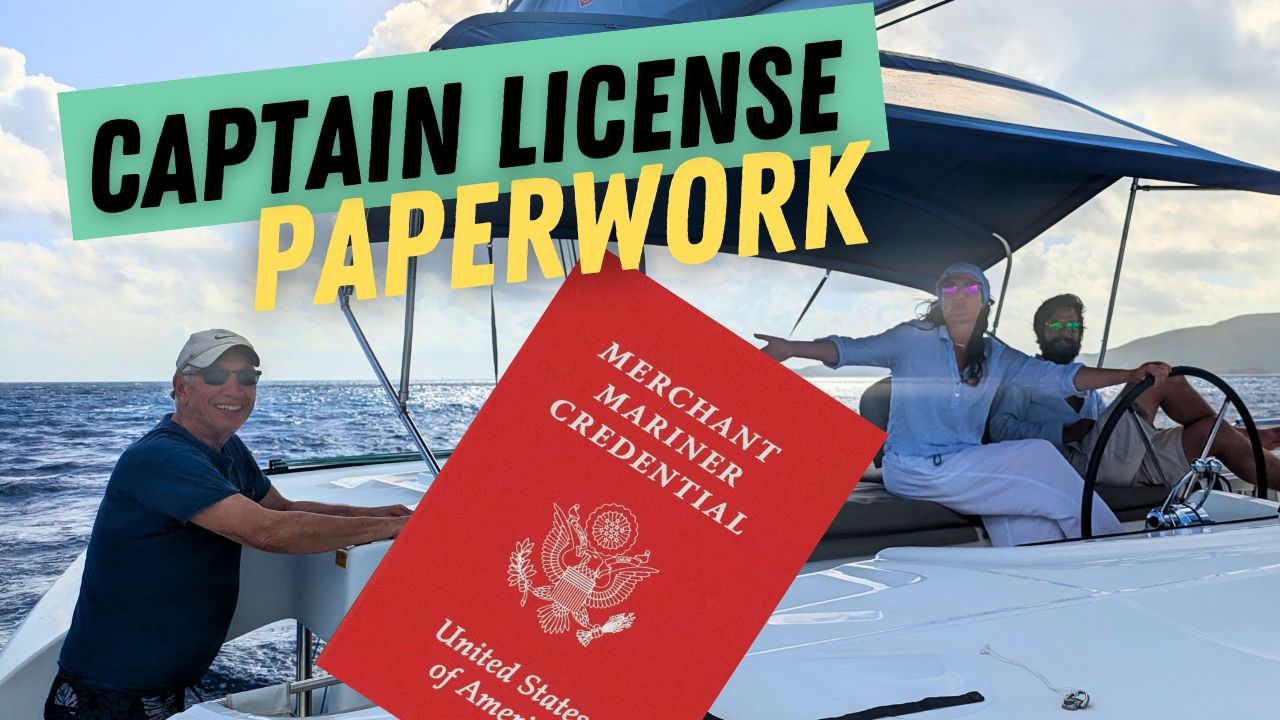
Step 3: The Paperwork (And the Thing It Found)
Form CG-719B is your actual application. Answer the background questions honestly. The Coast Guard has a long memory.
Sea service: 360 days documented, 90 of those near-coastal or ocean, 90 within the last three years. One CG-719S per vessel. Start logging now — you will not remember this as well as you think.
TWIC card: TSA-issued, in-person, fingerprints, weeks to arrive. Book this early. Before you even finish your class, if you can.
CPR/First Aid: Must be in-person, current within a year. Online doesn’t count.
The physical: This is where the checklist stopped being a checklist. My dad went in for a routine, required exam and came out with a surgery date — a cardiac issue, zero symptoms. He had the surgery. He’s fine. The doctors told him straight up: without this exact chain of events, they probably don’t catch it in time.
Timing matters: exam results and physical are good for a year. Drug test is only good for 185 days from MRO sign-off — shortest clock in the packet. Do TWIC first, physical whenever, drug test last so it doesn’t expire on you.
Fill out the forms. Be annoyed by all of it. Maybe be a little grateful too.
Quick Guide: Tonnage When Your Boat Doesn’t Have One
No documented tonnage on file? You don’t need a formal measurement just to fill out your sea service form. The Coast Guard’s own simplified formula works off three numbers you can grab with a tape measure: length, beam, and depth, in feet.
Powerboats: L × B × D × 0.67 ÷ 100
Sailboats: L × B × D × 0.5 ÷ 100
Example: 40 ft length, 13 ft beam, 7 ft depth (deck to bottom of keel) → 40 × 13 × 7 × 0.67 ÷ 100 ≈ 24 gross tons.
That’s not a Certificate of Documentation. It’s a defensible, federally-sourced number for the gross tons box instead of a shrug.
📺 Full paperwork breakdown: https://youtu.be/NIvn11JJcno
Boat on.